Showing posts with label car reviews. Show all posts

Review by jack : 2020 Hyundai Grand i10 Nios Turbo review, test drive

Think Hyundai Grand i10 Nios and you’d picture a practical, sophisticated, feature-loaded family car; sporty and exciting aren’t words that you’d associate with it. But Hyundai is working towards changing that perception withthis hot new turbocharged petrol version.

This Turbo version of the Nios is powered by a 1.0-litre, three-cylinder, turbo-petrol engine that made its debut in the Hyundai Venue, and is also available with sedans like the Verna and Aura. The Nios Turbo is based on the Sportz Dual Tone (DT) variant of the regular Nios with which it shares its features list, interiors and its exterior design; and it commands a premium of Rs 95,000-1,00,000 over the comparable 1.2-litre petrol engine. So, is the Nios Turbo exciting enough to justify that premium?

The Turbo badge is one of the few visual ques that differentiates the sportier version.

How do you distinguish the Turbo from the regular Nios?

Save for a fully blacked-out trapezoidal front grille featuring a ‘Turbo’ badge, there isn’t anything to tell this version apart from a regular dual-tone Nios. This turbo variant gets an optional two-tone paint shade with blacked-out roof and pillars (priced Rs 5,000 higher than the single tone), projector headlamps with LED DRLs, roof rails, and wide 175/60 tyres with 15-inch alloys from the top-spec Asta variant (as compared to the 165/65 R14 tyres available on the Sportz single-tone variant). The boot now wears an extra ‘Turbo’ badge, in addition to the ‘Grand i10’, ‘Nios’ and ‘Sportz’ badges.

The dual-tone finish costs Rs 5,000 more than the single-tone one.

Is the Nios Turbo’s interior much sportier?

Like the exteriors, the interiors get mere cosmetic changes, which are standard on the DT version. Red highlights around the air-vents and the rotary AC controls, as well as red stitching and piping on the seats, add a touch of sportiness to the all-black interiors. Although there aren’t any Turbo-specific changes to the interiors, the gear lever gives this one away, due to its reverse gear positioning that is besides the first gear, as opposed to being besides the fourth gear in the standard Nios. Cosmetic changes aside, the interiors are spacious and nicely put together with high-quality plastics. And this remains a practical cabin with a very user-friendly layout.

Red highlights inside mark the Nios Turbo apart.

Does the Nios Turbo get more features?

In terms of equipment, the Turbo features a leather-wrapped steering, climate control, a part-digital instrument cluster, touchscreen with Android Auto and Apple CarPlay, reverse camera, projector headlamps with LED DRLs, remote-key entry, and wireless charging. Compared to the top-spec Asta variant of the standard Nios, it misses out some convenience features like a push-button start and keyless entry, and some crucial bits like a rear wiper and washer.

The Nios Turbo Sportz misses out on keyless entry and go and a rear wiper available on the top-spec Asta variant.

What is it like to drive?

As mentioned earlier, this is the same 998cc, three-cylinder turbo-petrol engine that made its debut in the Hyundai Venue, but the only difference is that in the Nios, it makes 100hp – 20hp lesser than the compact SUV – but still produces an identical 172Nm of torque. With a sub-1-tonne kerb weight, power-to-weight and torque-to-weight ratios are better than any other affordable petrol hatchback in the market today.

This engine is smooth and refined, as far as three-cylinder motors go, but it isn’t completely vibration-free, especially at idle, when compared to its 1.2-litre four-cylinder naturally aspirated counterpart. When spun faster, this motor does get a bit thrummy, although the sound isn’t excessively loud or coarse.

The 1.0-litre turbo-petrol engine is shared with the Venue and Verna but makes 20hp less.

Those used to driving non-turbo cars will need to get accustomed to this turbo petrol engine, as on-tap responses aren’t as sharp as a larger naturally aspirated engine, and small-capacity turbo engines like this one need to be spun a bit to build the boost and bring them into their zone. You will do well by keeping the revs above 1,800rpm as that’s where the turbo starts singing, and there’s a nice second wind of power once the tachometer needle crosses 3,000rpm. Between 2,000-5,000rpm is this engine’s sweet spot, and it feels very gutsy and far more capable than the 1.2-litre petrol, especially while overtaking out on the highway. While it isn’t as free-revving as Volkswagen’s 1.0-litre TSI motor, it will spin to 6,600rpm in the first three gears, maxing out at 101kph in second gear and at 164kph in third gear, which goes to show how tall-geared this version is. Flat-out, it will even go on to hit a top speed of 183kph.

The Nios Turbo is the quickest mass market hatch to 100kph.

And while on the topic of outright performance, this is currently the fastest accelerating mass-market hatchback on sale in India. It out-accelerates the Volkswagen Polo 1.0 TSI (which was the previous fastest) to 100kph and it even reaches 160kph a full second quicker. Even through the gears, especially in the fourth, from 40-100kph, the Nios is 0.88sec quicker. Even when you consider smaller bursts of acceleration like 20-40kph in second gear, 40-60kph in third, or even 60-80kph in fourth, the Nios noses ahead when compared to the Volkswagen. The Nios’ standard 1.2-litre petrol version isn’t even in the same league in terms of performance. To put it into perspective, the Turbo accelerates 3.46sec, 0.7sec and 8.59sec faster than the naturally aspirated petrol from 0-100kph, 20-80kph in third and 40-100kph in fourth, respectively.

Hyundai Grand i10 Nios Turbo vs VW Polo 1.0 TSI vs Grand i10 Nios 1.2: Performance (as tested)
Grand i10 Nios Turbo Polo 1.0 TSI Grand i10 Nios 1.2P
0-10kph 0.52s 0.43s 0.52s
0-20kph 1.08s 1.06s 1.14s
0-30kph 1.62s 1.64s 2.16s
0-40kph 2.39s 2.28s 3.02s
0-50kph 3.29s 3.27s 4.11s
0-60kph 4.58s 4.23s 5.75s
0-70kph 5.69s 5.28s 7.20s
0-80kph 6.93s 6.51s 8.79s
0-90kph 8.23s 7.99s 10.78s
0-100kph 9.82s 9.97s 13.28s
0-110kph 12.17s 11.88s 15.89s
0-120kph 14.46s 14.14s 19.06s
0-130kph 17.12s 16.87s 23.31s
0-140kph 20.20s 20.36s 29.60s
0-150kph 23.92s 24.75s -
0-160kph 29.30s 30.36s -
20-80kph (in 3rd gear) 13.30s 12.36s 14.00s
40-100kph (in 4th gear) 13.85s 14.73s 22.44s

This motor is mated to a 5-speed manual in the Nios Turbo (as compared to the Venue’s 6-speeder). The gearbox is an absolute delight to use, with butter-smooth shifts and a light and positive action. Its clutch is light too, and so is its steering, which is effortless to twirl at city speeds. Out on the open road, however, you will be left wanting for a more consistent feel, and although the steering weighs up a bit at speeds, it doesn’t offer a very ‘connected’ feel.  And while mechanical grip is decent – with its wheels pushed to the extreme corners of the car, making it feel quite agile – road grip from the skinny tyres, however, isn’t very confidence inspiring. A set of wider tyres would improve its cornering ability to a great extent. Like the standard car, ride comfort remains excellent, and its brakes are very progressive, offering a strong initial bite.

5-speed manual is a delight to use.

Should you buy the Nios Turbo?

Despite being a spruced-up version, this car retains all the Nios’ strengths, like its sophisticated, practical interiors, an absorbent low-speed ride quality, and its easy-to-drive nature, which makes the standard car very appealing in the first place. Hyundai must be lauded for taking the plunge and introducing this performance-oriented turbo version to cater to the driving enthusiasts – the added performance has made the Nios a lot more capable and more effortless, especially out on the open road. Performance is so strong that this one is the quickest hatchback on sale in India today. But those who love to drive will be left wanting for a more engaging driving experience to match the added performance, and the Rs 95,000-1,00,000 premium that this turbo version commands over a comparable 1.2-litre petrol variant seems a bit too hard to justify. Sharper driving manners and sportier looks would have made the Nios Turbo a purer hot hatch and a more compelling proposition.

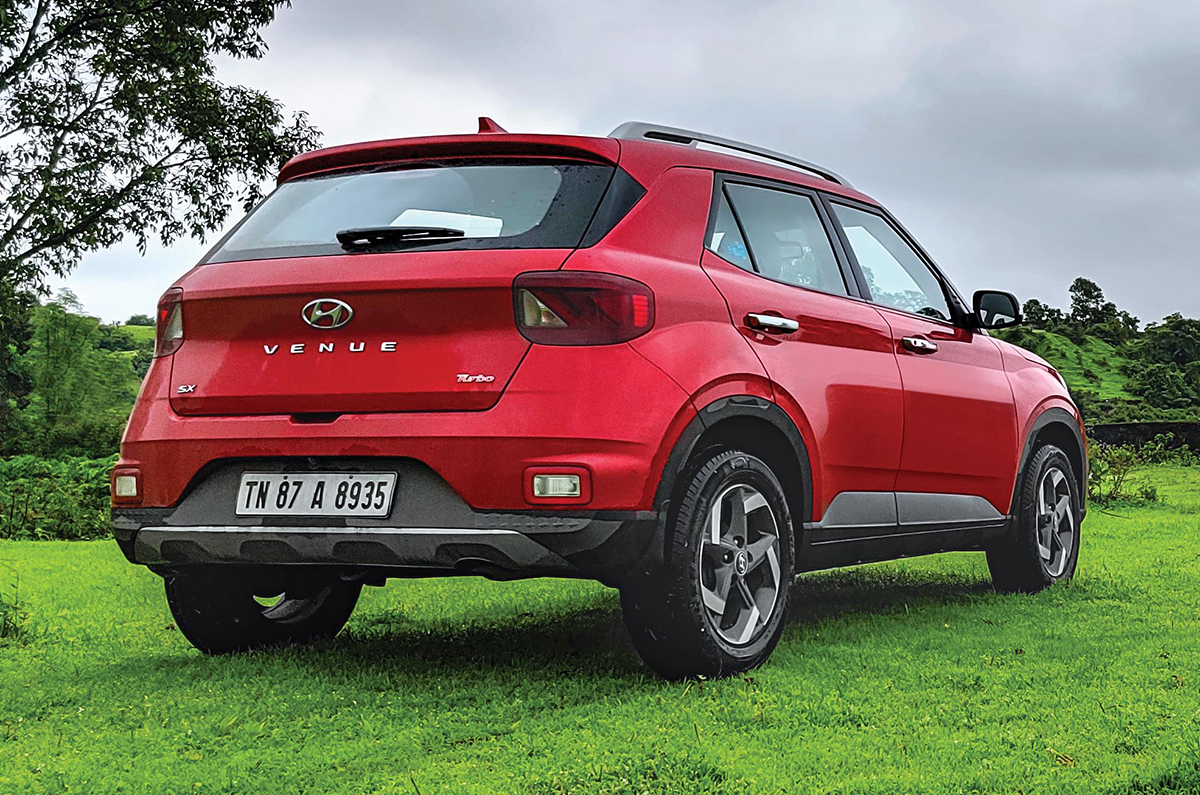
The Rs 95,000-1,00,000 premium for the Turbo over the standard 1.2 petrol is a bit hard to justify.


Review by j@ck : Hyundai Venue long term review

It’s ironic, but owner have actually clocked more kilometres on our long-term Venue in these work-from-home times than anyone ordinarily would have. And that’s despite the Venue having been parked for much of the three months since the last report. The 3,700km added in the time have largely come from the Venue’s deployment as a support car on shoots. Social-distancing norms dictate we limit the number of crew members in a car so where one support car (our trusty Lodgy) would suffice in the past, now we need up to three, depending on the scale of the shoot. This has translated into more outings for the Venue than usual.

The bulk of my driving has been on the highway. This is reflected in the fuel-economy numbers. Our Venue 1.0 Turbo manual has been averaging around 16kpl, with the MID reading upwards of 18kpl for instant economy when cruising at 80-100kph on the Mumbai-Pune expressway. Welcome economic ramifications aside, the good fuel-economy has also equalled fewer visits to petrol pumps. Amidst this pandemic, anything that minimises physical contact deserves to be highlighted.

Long Ranger: Good fuel economy equals fewer stops to tank-up. A big plus in these times.

Over these frequent highway jaunts, I’ve learned that the Venue Turbo with the manual gearbox is a reasonable mile muncher. It gets up to speed quickly and this top-spec SX(O) version also brings in the luxury of cruise control. It’s just that I find myself reaching out for the gear lever to downshift every time I need more from the engine. The 1.0 turbo-petrol is not as effortless as the torquier 1.5 diesel at highways speeds, in case you are considering a Venue as a long-distance car.Since it’s just two people in a car these days, the Venue’s relatively limited rear-seat space.What has impressed all and sundry is the Venue’s boot space. 

Stand Firm: The suspension is set up on the firmer side. This is felt most by those seated at the back.

With‘unlocking’, traffic is returning to pre-COVID-19 levels and that has made the last part of our return journeys a slog. The Hyundai’s light steering and slick gearbox ease life in heavy traffic; but I have to admit that the concept of a clutchless manual, as debuted on the Venue iMT, does sound really promising. Gavin came away impressed by the system and it’s something I’m itching to try.

Check. Mic Testing. Check: The mic has stopped working, so no more Bluetooth phone calls or voice-activated commands.

A bugbear on our Venue remains its temperamental infotainment system mic. It’s been repaired once already but has gone kaput again. At a time when most work happens on the phone, a non-functional car mic is immensely frustrating. I sincerely hope Hyundai’s technicians can find a long-term fix at the Venue’s next service that’s due soon. 


Auto Marvel : Jeep - Stories begin where the roads end.


THE BIRTH OF A LEGEND

The 1940 Willys Quad was the first Jeep 4x4 ever made, but the Willys MA (‘M’ stood for ‘Military’ and model ‘A’), built in 1941, is equally iconic. Built to US Army specs just before WW-II, the MA had headlights on top of the fender, a Spicer 18 transfer case, and 3-speed manual transmission.

The go-anywhere, do-anything 1942 Jeep Willys MB was cut out for combat. It could be fitted with guns, was used for desert patrol, and also served as fire-fighting pumpers, field ambulances – and hell, fitted with appropriate wheels, it would even run on railway tracks.

When the war ended, Jeep returned to a hero’s welcome in the United States. In due course, the first Civilian Jeep (or CJ) was born. The CJ-2A, a modified version of the Willys MB, featured better shock absorbers, springs, and more comfortable seats.

The Wrangler YJ was the genesis of the Wrangler line. Launched in 1986, it came with four- and six-cylinder engines and updates to the 4x4 system such as Command-Trac and Selec-Trak.

WHAT JEEP STANDS FOR

Jeep is a thoroughbred SUV brand that was created nearly 80 years ago. It was purpose-built to help carry American armed forces safely over unforgiving terrain. Since then, with its legendary 4x4 engineering technology, Jeep has earned an iconic status because it created authentic SUV products, ushering in a new ‘4x4’ era in mobility. Jeep SUVs soon captured the imagination as they accorded a lifestyle of freedom and adventure. Over the years, Jeep has evolved into this brand that brings people together, builds communities and allows people to go anywhere and do anything. Today, Jeep is a household name, with vehicles that cater to all needs. Even as the brand has evolved, Jeep vehicles take pride in being rooted to their origin. Today, Jeep products retain their signature seven-slot grille, trapezoidal wheel arches, and unmatched and ever-improving 4x4 capability. Jeep has captured the imagination to become an inspiration and remain a beacon amongst Sports Utility Vehicles. It has the integrity of originality at its core. A quality we all value, aspiring to rise above mediocrity. We see in our choices, a reflection of who we are, or who we want to become. There is and will be only one Jeep.

— Dr Partha Datta, 

President and Managing Director, Fiat Chrysler Automobiles, India.


JEEP IN INDIA

Launched in 2019, the Jeep Compass Trailhawk isn’t fazed by anything. Steep ascents, rutted tracks, acres of mud: it’s all in a day’s work for this rugged-set version of the Compass.


The Compass marked Jeep’s foray into India. It was launched in 2017.
 
The Jeep Compass was the Car of the Year, Viewers’ Choice of the Year, and Premium SUV of the Year at the 2018 Autocar Awards. The Compass Trailhawk took home the Variant of the Year title at Autocar Awards 2020.
 
The badge says it all. This Trailhawk’s the real G.O.A.T.
 
Not impressed with the usual mode selector? Well, here, then, is a Rock mode. Go forth and conquer with the Compass Trailhawk.
 
Body-on-frame, tough as nails: With a 41.8-degree approach angle and 36.1-degree departure angle, the Jeep Wrangler really means business.
 
The Wrangler is Jeep’s flagship and the most recognised vehicle in the world, with its iconic seven-slot keystone-shape grille, round headlamps, trapezoidal wheel arches and square tail-lamps.
 

Jeep has nine Jeep Life Clubs in India with 2,800 active members who enthusiastically engage in expeditions, local trails, meet-ups and CSR drives.
 
 
Legendary Jeep Trails is a signature Jeep expedition, organised once a year for Jeep SUV owners to drive over the toughest terrains India has to offer and experience the capability of their Jeep SUV first-hand.


Hyundai increases lead in SUV segment post lockdown

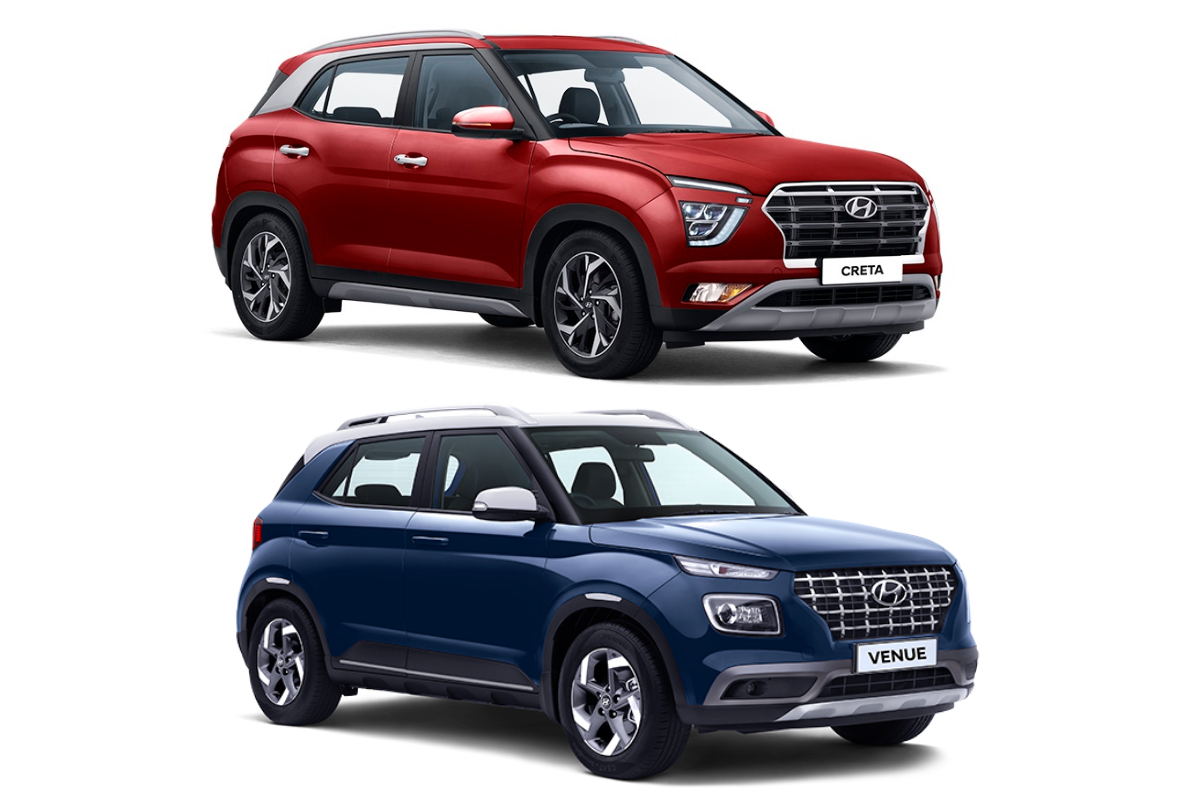
The Indian auto industry is arguably witnessing its toughest phase in recent times, with the coronavirus induced economic crisis crippling demand. While Hyundai’s sales have also been badly hit like the rest of its competitors, the Korean automaker has managed to expand its SUV market share and gain the leadership position by posting sales of 54,402 units in the SUV segment in FY2021 (till August), on the back of (relatively) strong demand for the Creta and Venue.

Let’s take a closer look at how both the models have helped Hyundai gain the upper hand in the SUV space.   

  • Hyundai Creta was the best-selling SUV in April-August 2020 
  • Hyundai Venue topped the compact SUV sales chart in April-August 2020
  • Hyundai increases SUV market share by 2.20 percent 

Hyundai Creta: The best-selling SUV in April-August 2020

The new Hyundai Creta was launched on March 16, 2020, just a week prior to the nationwide lockdown. After the Indian auto industry witnessed a month of zero sales in April, the Creta became the best-selling SUV in the country next month and it has managed to hold on to the title till now, with the latest industry figures for August 2020 putting it at the top of the SUV sales chart yet again.

In the April-August 2020 period, the Creta saw dispatches of 33,726 units – 6,076 units higher than its sibling, and closest competitor, the Kia Seltos. Moreover, the second-gen SUV’s sales have been consistently rising since May 2020 (3,212 units), with August registering the highest sales of 11,758 units. New products are known to witness a buoyed demand in the initial phase and the true test lies in the Creta being able to continue the momentum in the coming months.     

Nonetheless, the success of the 2020 Creta also shows the ability of new models to excite the market and revive demand, even during troubled times like these. Many automakers are hoping to mirror the strategy by lining up their launches for the coming months.  

Top 5 selling mid-size SUVs
Model April-August 2020 sales
Hyundai Creta 33,726
Kia Seltos 27,650
Mahindra Scorpio 9,749
MG Hector 7,294
Tata Harrier 3,493

Hyundai Venue tops compact SUV sales chart

The Hyundai Venue has also proven to be a consistent performer for the Korean automaker. The sub-four metre model registered sales of 20,372 units in the April-August 2020 period, just about enough to top the compact SUV sales chart and edge past the Maruti Suzuki Vitara Brezza which sold 19,824 units.

Hyundai has been quick on the draw with introducing minor updates to the Venue, in an effort to maintain its lead. In addition to upgrading the model to BS6 norms earlier this year, the car major has added a new ‘Sport’ trim and a clutchless manual gearbox, or intelligent manual transmission (iMT) in Hyundai speak, to the line-up.

Top 5 selling compact SUVs
Model April-August 2020 sales
Hyundai Venue 20,372
Maruti Suzuki Vitara Brezza 19,824
Tata Nexon 13,169
Mahindra XUV300 8,578
Ford EcoSport 6,738

Hyundai takes the lead in SUV segment post lockdown 

Hyundai took the lead in the SUV segment in the April-August 2020 period by registering combined sales of 54,402 units for the Creta, Venue, Tucson and Kona Electric, while Mahindra came in second with sales of 34,914 SUVs. The positions are reversed compared to the same period last year when the Korean automaker was trailing behind the segment leader Mahindra, albeit by just 654 units.

Sale of 54,402 SUVs in April-August this year has given Hyundai a market share of 30.03 percent in the SUV segment, an increase of 2.20 percent vis-à-vis the same period last year. Together with its sister company Kia, the Korean counterparts accounted for a substantial 45.29 percent, or almost half, of the SUVs sold in our market in FY2021 (till August).

SUV sales
Company April-August 2020 sales April-August 2019 sales April-August 2020 market share April-August 2019 market share Market share change
FCA (Jeep) 1,207 4,086 0.67% 1.50% -0.84%
Ford 8,479 19,182 4.68% 7.06% -2.37%
Honda 25 358 0.01% 0.13% -0.12%
Hyundai 54,402 75,680 30.03% 27.84% 2.20%
Kia 27,650 6,236 15.26% 2.29% 12.97%
Mahindra 34,914 76,334 19.28% 28.08% -8.80%
Maruti Suzuki 24,513 48,197 13.53% 17.73% -4.19%
MG 7,678 3,526 4.24% 1.30% 2.94%
Nissan 424 1,185 0.23% 0.44% -0.20%
Renault 1,083 4,573 0.60% 1.68% -1.08%
Skoda 568 446 0.31% 0.16% 0.15%
Tata 16,662 25,461 9.20% 9.36% -0.17%
Toyota 2,609 6,289 1.44% 2.31% -0.87%
Volkswagen 921 325 0.51% 0.12% 0.39%
TOTAL 1,81,135 2,71,878 100.00% 100.00% 0.00%

Leveraging the rapidly increasing consumer interest in the compact and mid-size SUV segments, Hyundai has extended its advantage in the SUV space. However, with the Seltos continuing to put up a good show and the launch of the highly anticipated Kia Sonet lined up for later this month, Hyundai could soon see that lead diminish. Nonetheless, it is evident that the two Korean automakers have together conquered the Indian SUV segment.

Also see:

Hyundai Venue iMT review, test drive

2019 Hyundai Venue review, test drive

2020 Hyundai Creta vs Kia Seltos comparison


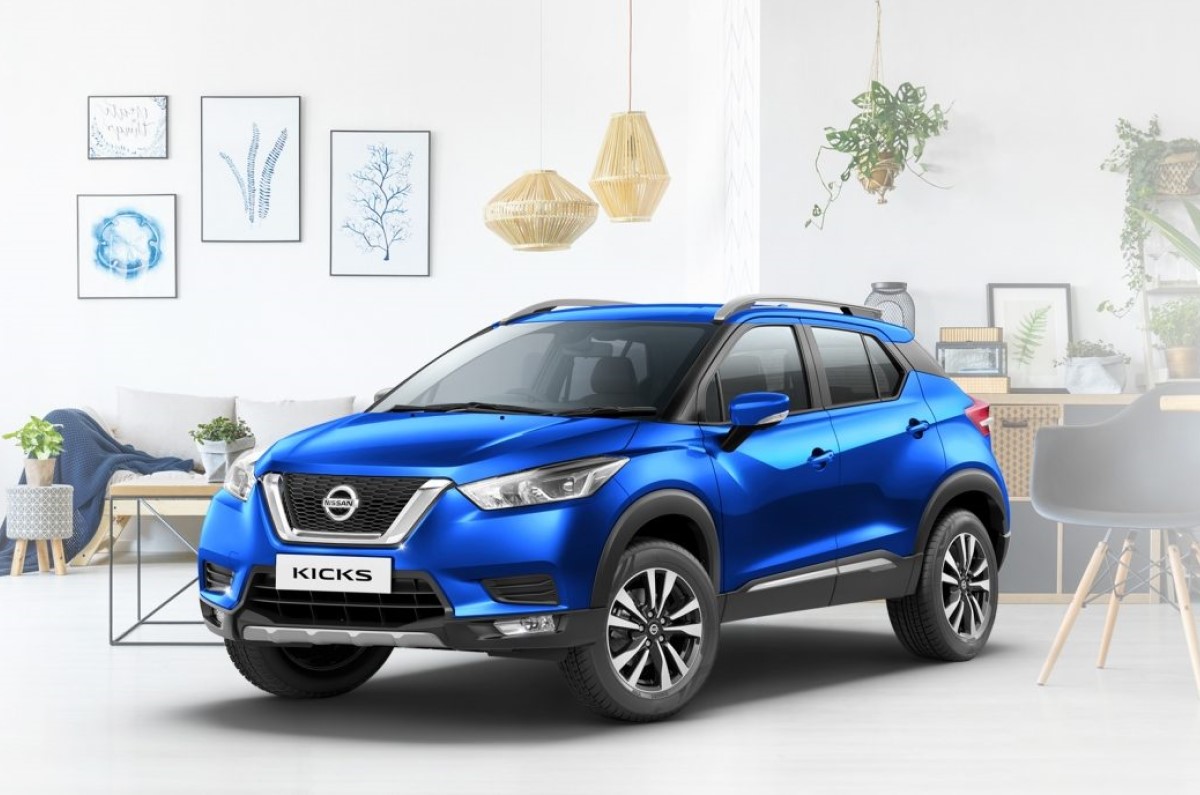
Nissan Kicks gets discounts and benefits of up to Rs 75,000

The Nissan Kicks can be bought this month with benefits and discounts worth up to Rs 75,000. The start of the festive season usually means carmakers offer deals across all dealerships to draw buyers to showrooms. For September 2020, Nissan India has rolled out discounts for its sole mainstream offering, the Kicks.

  • Up to Rs 75,000 off for select Nissan Kicks buyers
  • Valid on all variants and engine-gearbox combinations

What benefits are available with the Nissan Kicks this month?

Nissan dealerships have been authorised to offer up to Rs 45,000 in exchange benefits and a loyalty benefit of Rs 10,000. A corporate offer of up to Rs 10,000 is also available. Make a booking for your new Kicks before September 15, and avail of an additional Rs 15,000 worth of benefits.

Are benefits available with all Nissan Kicks variants this month?

All eight versions – three engine-gearbox options and four trim levels – are available with the same benefits. The Kicks now has two petrol engine options – a 106hp, 1.5-litre naturally aspirated unit and a 156hp, 1.3-litre turbo-petrol mill. The former gets a 5-speed manual gearbox as standard while the latter is available with 6-speed manual and CVT automatic options. We’ve driven the Kicks turbo in manual form and came away impressed with its low- and mid-range punch.

Nissan Kicks prices (Rs 9.50-10.00 lakh for the 1.5 petrol and Rs 11.85-14.15 lakh for the 1.3 turbo petrol) are competitive for its class, which includes rivals like the Renault Duster, Kia Seltos, Hyundai Creta and Maruti Suzuki S-Cross.

Also see:

Nissan speeds up carbon fibre reinforced plastic production process

2020 Nissan Kicks turbo-petrol video review

Nissan Magnite design centred around balanced proportions and packaging


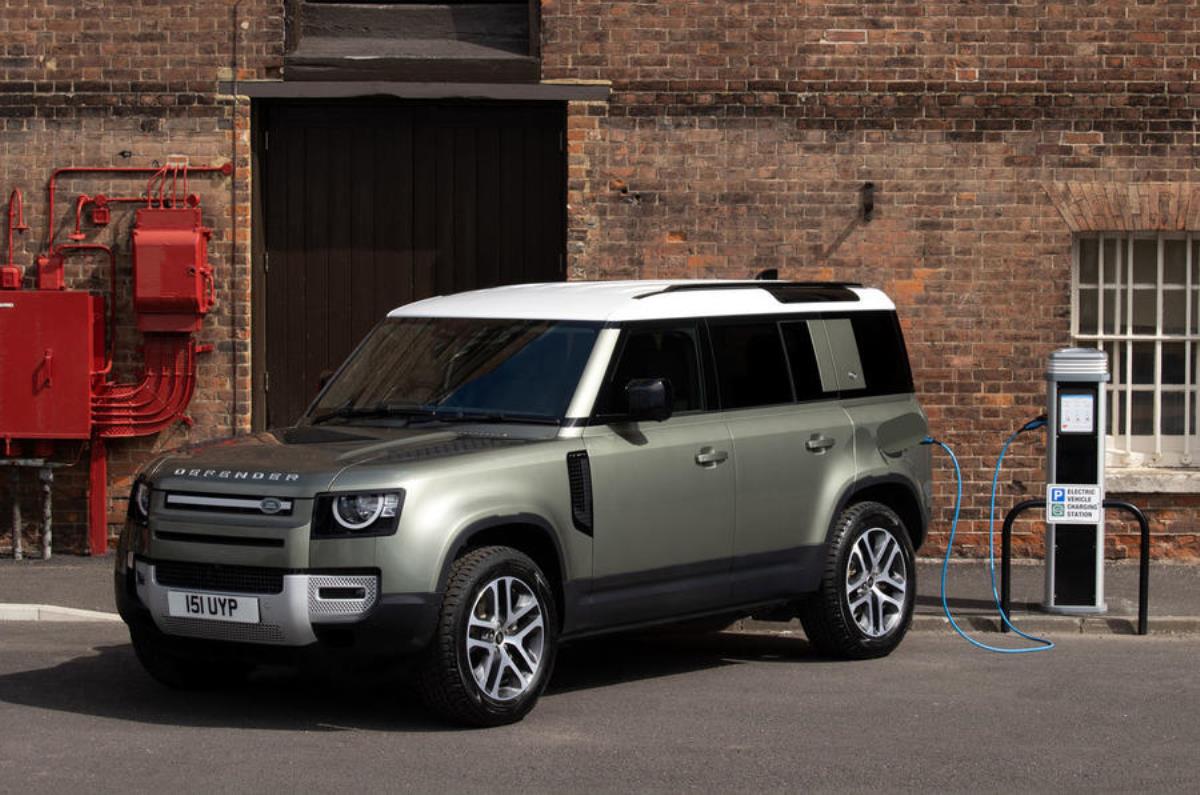
Land Rover Defender P400e plug-in hybrid variant revealed

The Land Rover Defender has received a range of updates for the 2021 model year line-up, including a new plug-in hybrid petrol engine and a new diesel engine with mild-hybrid tech. Sales of the short wheelbase Defender 90 variant, which were  delayed due to the impact of Covid-19 lockdowns, have also commenced in international markets, though bookings in India are still on hold. 

  • 404hp P400e variant capable of 43km electric only range
  • New six-cylinder diesel engine available in three states of tune
  • Defender 90 global sales have begun; India bookings still on hold

2020 Land Rover Defender: New plug-in hybrid petrol engine

The first plug-in hybrid Land Rover Defender will globally go on sale next year, with a 404hp powertrain capable of 43km of electric-only running and the promise that it will be “the most capable and durable” version of the off-roader.

The new Defender P400e plug-in hybrid electric vehicle (PHEV) option will be offered only in long-wheelbase 110 form initially. It uses the same powertrain as the Range Rover and Range Rover Sport. This mates a 300hp, 2.0-litre four-cylinder petrol engine to a 143hp electric motor.

Land Rover claims the model will offer “substantial torque” that will add to the rugged machine's off-road capability. The powertrain can achieve 0-100kph in 5.6sec and a top speed of 209kph. 

The Defender P400e features 20-inch wheels and electric air suspension as standard, with its powertrain tuned to allow electric-only running in low-range mode, both on and off-road.

Charging of its 19.2kWh battery comes via a Mode 3 connection using a charging power socket on the left of the vehicle, while a Mode 2 connector is available as an option. An 80 percent charge takes around half an hour on a 50kW rapid charger. Regenerative braking is also used.

The P400e is available with either five or six seats, and includes privacy glass and climate control as standard.

2020 Land Rover Defender: Diesel engine gain mild hybrid tech

Alongside the plug-in hybrid, Land Rover has added a new 3.0-litre six-cylinder Ingenium diesel engine to the Defender line-up. Using mild-hybrid technology to increase efficiency, it will be offered in three outputs, starting with the D200 (200hp and 500Nm) and the D250 (249hp and 570Nm), replacing the 2.0-litre four-cylinder unit previously featured in the range in D200 and D240 states of tune. On the Defender 110, the new D200 achieves 0-100kph in 10.2sec, with the D250 cutting that to 8.3secs.

The new D300 variant will sit atop the Defender's diesel engine line-up, producing 300hp and 650Nm of torque, with a 0-100kph time of 6.7sec on the Defender 90.

Defender 90 goes on sale globally

After a delayed market launch of the Defender 90 due to Covid-19 related lockdowns, the short wheelbase, three-door model has now gone on sale in international markets.

It will be offered with the same petrol and diesel engines offered in the larger 110, with the P300 and P400 petrol units joined by the D200, D250 and D300 diesel units. As with the 110, all the Defender 90 models use an eight-speed automatic gearbox. Petrol versions feature all-wheel-drive, while the Ingenium diesels use the new, intelligent all-wheel-drive system.

2020 Land Rover Defender: India outlook

Land Rover India had announced pricing for the off-roader, earlier this year. The Defender is priced at Rs 69.99-86.27 lakh (ex-showroom, India) in our market and is available in both, the 3-door 90 form as well as the 5-door 110 iteration.  

Though Defender 90 sales have commenced abroad, dealer sources have confirmed that bookings for the model continue to be on hold for our market, with no word on the expected timeframe of its arrival. Deliveries of the Defender 110 will, however, begin next month. 

The Land Rover SUV has initially been launched in India with a sole 300hp, 2.0-litre four-cylinder turbo-petrol engine (P300). A diesel powertrain option is also expected down the line, though there is no official communication on the P400e PHEV variant.

We drove the new avatar of the British marque’s legendary off-roader in Namibia earlier this year. Click here for our exclusive review of the new Land Rover Defender.   

Also see:

Land Rover Defender to get range-topping V8 model

The story behind the new Land Rover Defender’s production


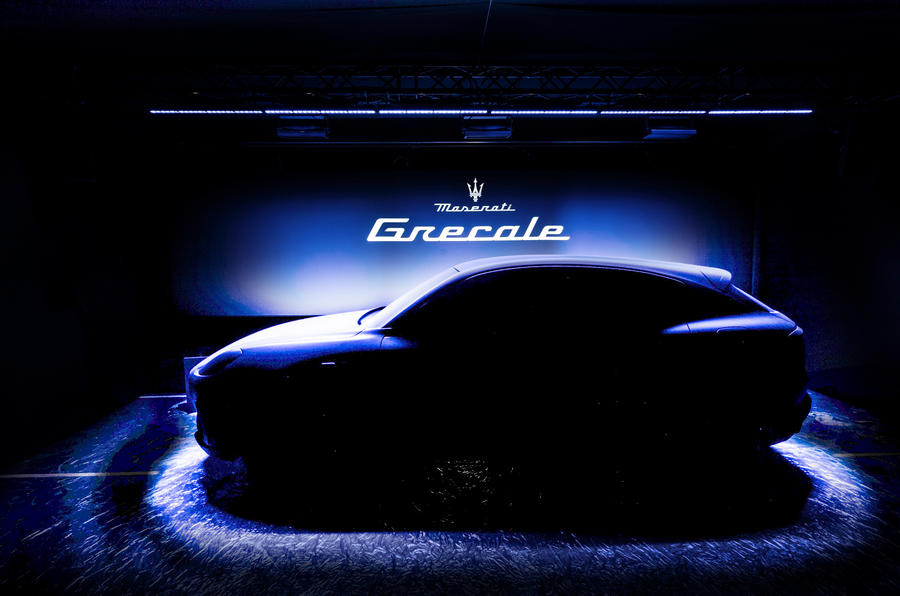
Maserati Grecale SUV to debut in 2021

The Maserati Grecale name has been confirmed for the Italian carmaker’s sub-Levante SUV that is due to arrive next year. The new SUV is part of the band’s ambitious revival plans that will see it introduce 13 new models by 2024 which includes the just unveiled supercar, the MC20.

  • All-new small SUV to share underpinnings with the Alfa Romeo Stelvio
  • Grecale to come with Maserati engines
  • SUV to be followed up by new GranTurismo, GranCabrio, Quattroporte and second-gen Levante by 2024

What do we know about the Maserati Grecale?

The brand's important second SUV, following the larger Levante, the Grecale is named after the "fierce north-east wind of the Mediterranean Sea". Destined to play "a key role in the brand's development", the Porsche Macan rival will be built on the same production line as the Alfa Romeo Stelvio in the Fiat Chrysler Automobiles (FCA) plant in Cassino, Italy.

The new SUV was first confirmed back in 2018 by former FCA boss Sergio Marchionne, as part of a total overhaul of its product line-up.

It will also share much of its underpinnings with the Stelvio, and a fully electric version is also due to arrive by 2022. However, the combustion engine models will use Maserati rather than Alfa-sourced engines.

Maserati global planning boss, Francesco Tonon, told our sister publication AutocarUK, that the Grecale will be "the most practical in its class, but it will also be luxurious". Further adding he said,  "It will feature the best in class design and features. Of course it's still a Maserati, but it will also offer best-in-class performance and handling".

Maserati is eyeing for 70 percent of its sales to account from SUVs by 2025 with sedans and sports cars amounting for the remainder.

Folgore: Maserati EV sub-brand

Come 2022, Maserati will begin the roll-out of its electric vehicle range which will comprise of the EV derivates of its entire new model line-up. The fully electric models will all be branded Folgore, meaning thunderbolt in Italian and feature a three-motor set-up, with one motor on the front axle and two on the rear. That will enable all-wheel-drive and torque vectoring, with power able to be adjusted to each axle depending on traction.

The EV system will use 800V technology enabling charging rates of up to 300kW, with silicon carbide inverters. Used in Formula 1 and Formula E powertrains, Maserati claims it will allow for more efficient running and longer range.

What models comprise Maserati’s 13 new model blitz?

As mentioned above, Maserati’s new car blitz begins with the MC20 which goes on sale in international markets in 2021. In the same year, it will be joined by the all-new Grecale SUV along with the new generation of the GranCabrio and GranTurismo with the all-electric versions of all four models expected to arrive in 2022.

By 2023, an all-new Quattroporte will arrive with combustion and full electric variants. It will be followed by the next-generation Levante SUV, again with both combustion and EV powertrains.

Maserati to open new customisation shop in Modena

Maserati also plans to expand its customisation options through a new Fuoriserie programme, which will see a new "car tailoring" shop created at its Modena headquarters. Customers will be able to hand-craft their cars from a choice of three basic collections, across the entire model range.

Will the Maserati Grecale come to India?

Given the Indian buyer’s preference for SUVs, Maserati could bring its smaller SUV to the Indian market in a bid to access new segments. The carmaker is also expected to launch its recently revealed MC20 in India. While it has also begun accepting bookings for three new variants of its current line-up, the Ghibli, Quattroporte and LevanteTrofeo.

Also see:

Maserati to expand India footprint


Review by j@ck : Kia Sonet


Kia really made a mark in the mid-size SUV space with the Seltos, and now, with its compact SUV the Sonet, it’s looking for another mega hit. Like the Seltos, the Sonet is an all-new model for Kia that made its global debut right here in India and will later be sold in other markets.

It shares a platform with the Hyundai Venue, and though you’d expect the Sonet to feel the same from behind the wheel, the two Korean firms take a very divergent approach with their platform sharing. Unlike the badge-engineered or mild-facelift alterations we’ve seen others opt for, Hyundai and Kia have made sure their shared products have little in common. The exteriors and interiors bear no similarity, and both also feel a bit different to drive, thanks to subtle changes to the tuning of the engine and suspension.


There are four engines. An 83hp, 1.2-litre petrol mated to a 5-speed manual, a 120hp, 1.0-litre turbo petrol mated to a 7-speed DCT auto or a 6-speed iMT (clutchless manual), and a 1.5-litre diesel that puts out 100hp when coupled to a 6-speed manual.

What’s the Kia Sonet diesel auto like?

Interestingly, the diesel is the same powertrain that does duty in the Seltos, putting out an identical 115hp and 250Nm. The diesel manual gets the fixed-geometry-turbo engine (instead of the variable-geometry unit on the auto) and puts out a lower 100hp and 240Nm of torque.

How about the Kia Sonet turbo-petrol?

The 1.0-litre turbo-petrol is shared with the Venue, and while Hyundai offers it with a manual, DCT or iMT, Kia only offers the Sonet with the DCT and iMT. The engine puts out the same 120hp and 172Nm as the Venue and the all-aluminium unit is nicely balanced, so you can hardly feel the typical thrum of a three-pot motor. Refinement is also very good and it’s only when you rev it to the redline that it gets a bit vocal. The punchy midrange and the ease with which it builds power makes it a fun drive, and while there are no paddle shifters like you get in the Venue, there is a sequential function via the gear lever, so enthusiasts can engage with the gearbox and this feisty engine.


What is the Kia Sonet’s performance like?

The diesel auto was the quickest. In a quick test, it did the dash to 100kph in just 11.48sec compared to the petrol DCT’s 12.25sec and 13.37sec for the iMT. The diesel was also ahead in the roll-on acceleration runs, registering 8.09sec from 40-100kph and 6.29sec from 20-80kph. The petrol DCT posted a slower 9.10sec and 7.48sec for the same 40-100kph and 20-80kph runs; being autos, of course, both times were the result of a sharp kick-down on the accelerator in full auto driving. The iMT posted 13.55secfor 40-100kph in fourth gear and 11.19sec for 20-80kph in third gear.

Kia Sonet performance (as tested)*

Sonet 1.0 Turbo iMT

Sonet 1.0 Turbo DCT

Sonet 1.5 Diesel AT

0-20kph

1.48s

1.56s

1.17s

0-40kph

3.27s

3.40s

2.51s

0-60kph

6.12s

5.78s

4.70s

0-80kph

9.38s

8.90s

7.78s

0-100kph

13.37s

12.25s

11.48s

0-120kph

19.87s

17.28s

15.76s

20-80kph

11.19s (in 3rd gear)

7.48s (in kickdown)

6.29s (in kickdown)

40-100kph

13.55s (in 4th gear)

9.10s (in kickdown)

8.09s (in kickdown)

*Performance figures not to standards

How is the Kia Sonet’s ride and handling?

In terms of handling, the diesel and petrol feel a bit different. The diesel has a slightly heavier steering and is a bit more nose heavy. The petrol felt nicer to steer and turned into corners with a bit more agility. Both cars feel nicely planted and offer a great degree of confidence at high speeds, which makes them good long-distance cruisers. Overall grip through corners is good, and body roll is well contained. The steering feel on both is pretty similar – there isn’t much feedback, but on the plus side, it is light enough in the city and has enough weight at higher speeds. The light controls, decent all-round visibility, tight turning circle and compact dimensions make the Sonet very urban-friendly and easy to slot into tight parking spots.

The drive modes do alter the steering feel, though the influence is minimal and only felt in Sport mode, with the steering firming up a bit. Unique to the segment, the Sonet also offers traction modes (Snow, Mud and Sand). We couldn’t get round to testing these, but will certainly go through them in detail in our full-blown road test.

What’s it like on the outside?

The front, of course, carries the signature Kia ‘Tiger Nose’ grille, which has a nice knurled and chrome-finished lower edge, and on the GT Line, there are some neat red accents too. The headlights are slim LED units with the signature ‘heartbeat’ DRL light design, and they sit atop a very sharply cut bumper that houses the fog lights and a faux skid plate. Topping off the front, the bonnet has a nice and subtle power bulge.

What’s the Kia Sonet’s interior like?

In terms of interior space, it’s no surprise the Sonet is similar to the Venue, and that means space is not class leading. Like with the Venue, the rear seat is relatively cramped and best for two not-too-tall passengers. The rear seat itself is quite comfy, with plush padding, though thigh support is a bit short. Up front, it’s a different story. The front seats are large, well bolstered and ventilated which, in peak summer, is a big plus.


Ventilated front seats are unique in this segment and are quite comfortable.

Where the Sonet really scores is with cabin quality. The choice of materials used gives a quality feel that’s not just better than rivals (the Venue included), but also cars of a segment above. The richly textured dashboard top, the chunky steering wheel with superbly crafted buttons, and the overall tactile feel of all the switchgear are top class. Personally, I’m not a fan of the central air-con vents’ look, but love the way they adjust with a solid and damped feel. I’m also not a fan of the digital instrument cluster and would have preferred a traditional needle to display speed, but I suppose it’s been designed for the new ‘digital’ customer.


Should you buy a Kia Sonet?

It’s beautifully styled with good proportions and lots of striking details, the interiors are very well appointed, finished to a high order and packed with features, many of which are first in class. It’s also effortless and very enjoyable to drive, and the diesel auto overshadows the turbo-petrol in almost every way; it’s absolutely brilliant. There are also other powertrain options to choose from, depending on your budget.

Expect a Rs 6.5 to 11.9 lakh (ex-showroom) price tag for the Kia Sonet.

Of course, the pricing is a key factor in the Sonet’s ultimate success, but after what we’ve seen and driven, there’s no doubt that Kia has another winner on its hands.


Hero Maestro Edge 110 BS6 priced at Rs 60,950

Last week, the BS6-compliant Hero Maestro Edge 110 was added to the company’s website, but did not reveal the scooter’s pricing. Now, the website has been updated with that information and the Maestro Edge 110 prices start at Rs 60,950. The scooter will also be available in an alloy wheel variant which will cost you Rs 62,450 (ex-showroom, Delhi).

  • Hero Maestro Edge 110 price starts at Rs 60,950

  • Available in two variants 

  • Gets the engine from the Pleasure Plus and revised decals

What are the engine specifications of the Maestro Edge 110?

The Maestro Edge 110 shares its engine with the BS6 Pleasure Plus. The updated scooter now uses fuel-injection and makes 8.16hp and 8.75Nm, which is nearly identical to the figures the carburetor-fed BS4 model made.

Are there any cosmetic changes with the transition to BS6?

Another change comes in the form of the revised decals. The bold colour scheme now consists of a large ‘Edge’ decal and multiple stripes. The 110 also features a different exhaust muffler that looks identical to the one seen on the BS6 Maestro Edge 125. These changes have also resulted in the kerb weight going up by 2kg to 112kg.

What about the hardware components?

Suspension is handled by a telescopic fork and a single shock absorber at the rear. While the scooter does get a 12-inch front wheel, the rear continues to be a 10-inch unit. However, the bike does appear to be available only with drum brakes at both ends. As for the features, the BS6 Maestro Edge 110 comes equipped with an underseat light and USB port, an external fuel filler cap and a side stand indicator.

At this price point, how does it compare against its rivals?

With prices starting at Rs 60,950, the Hero maestro Edge 110 is more affordable than its rivals - the Honda Activa 6G (starts at Rs 65,419) and the TVS Jupiter (starts at Rs 63,552).

All prices, ex-showroom, Delhi.

Also see:

2020 Hero Glamour review, test ride

2020 Hero Passion Pro review, test ride

Hero 300cc adventure motorcycle: Your questions answered


D'ecore your car